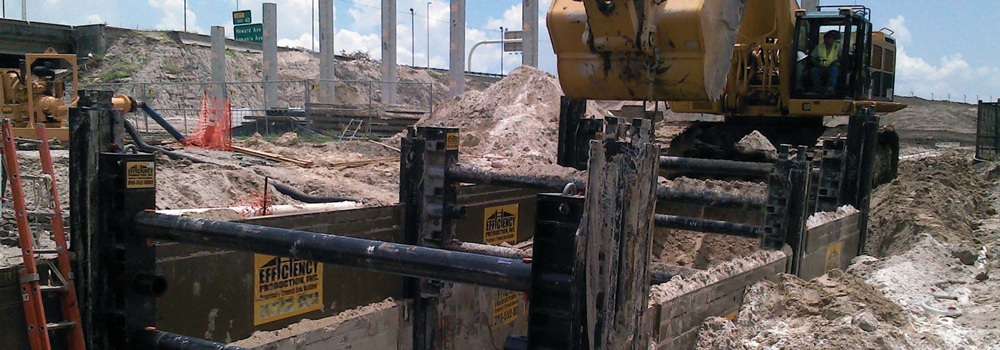
Construction workers enter trenches to install utilities, repair infrastructure and perform critical underground work. This job requires precision, as it carries one of the highest fatality rates in the industry. Trench collapses can happen in seconds, burying workers under thousands of pounds of soil.
Without proper protective systems, trenching puts lives at risk. Fortunately, the right shoring equipment, combined with an understanding of Occupational Safety and Health Administration (OSHA) standards, can prevent these accidents. Shoring equipment helps bring your crew home safely at the end of every shift. Whether you’re managing a small repair or a large-scale project, understanding the role of shoring equipment in trench safety is essential.
This guide provides the knowledge construction professionals need to run safe, compliant trenching operations. You’ll learn when protective systems are legally required, how to select the right equipment for your project and why renting offers strategic advantages over ownership.
Jump to Section:
- Why Shoring Is a Nonnegotiable Part of Trench Safety
- Understanding OSHA’s Trenching and Excavation Standards
- An Overview of Trench Protective Systems
- How to Select the Right Protective System for Your Project
- The Strategic Advantage of Renting Your Shoring Equipment
- Protect Your Crew With MacAllister Rentals
Why Shoring Is a Nonnegotiable Part of Trench Safety
Trench collapses remain one of the leading causes of death in the construction industry. A cubic yard of soil can weigh as much as a car, and when a wall caves in, workers have little time to escape.
The good news is, protective systems work. OSHA’s increased enforcement and safety outreach have led to a nearly 70% decline in trench collapse fatalities. This major reduction proves that when contractors prioritize protective measures, lives are saved.
Shoring equipment plays a central role in trenching safety. It isn’t merely a best practice or suggestion, but a fundamental requirement. According to the National Institute for Occupational Safety and Health (NIOSH), proper trench safety measures are critical to preventing excavation-related incidents. This equipment protects workers who perform essential work below ground level.
Understanding OSHA’s Trenching and Excavation Standards
OSHA’s trenching and excavation standards serve as the regulatory framework for safe underground work. Every project manager overseeing trench work should understand 29 CFR 1926, Subpart P, which outlines specific rules for excavation safety.
These standards exist to help keep workers safe in dangerous conditions. Soil behavior is often unpredictable, and even experienced professionals can misjudge stability. OSHA’s rules remove that guesswork by establishing clear thresholds based on decades of safety research and real-world incident analysis.
When Does the Law Require a Protective System?
OSHA’s excavation standards establish clear thresholds about when protective systems are legally mandatory. Understanding these requirements helps your projects stay compliant:
- Install protective systems — shoring, benching, sloping and shielding — for trenches 5 feet or deeper.
- Ensure a registered engineer approves all protective systems.
- Have a competent person inspect trenches daily for potential hazards.
- Locate and mark underground utilities before excavation.
- Place ladders laterally every 25 feet or less for safe entrance and exit.
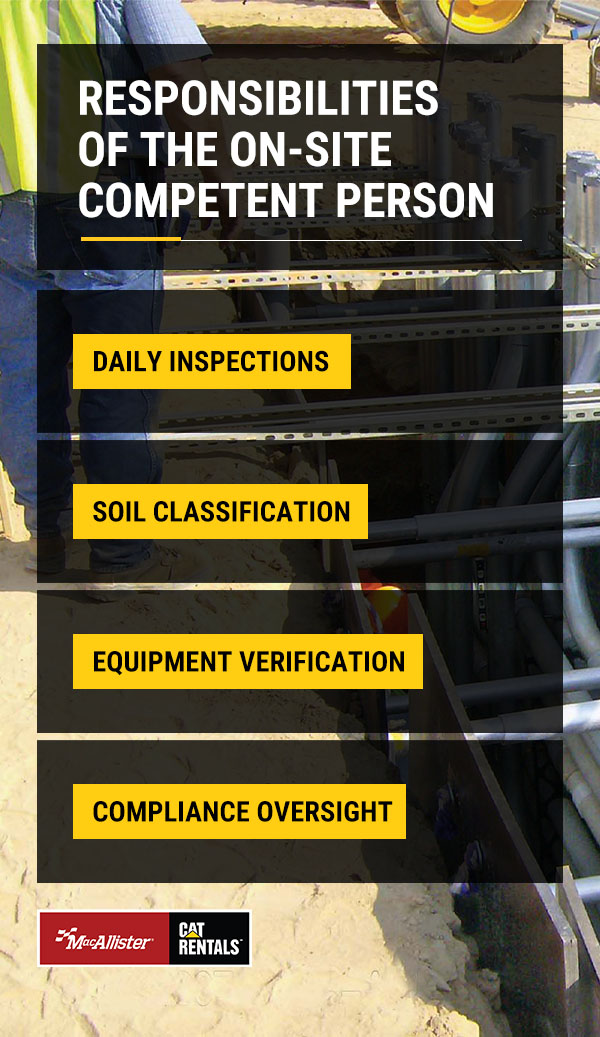
Responsibilities of the On-Site Competent Person
OSHA describes a “competent person” as someone who can identify and correct hazards in a project’s working conditions or surroundings. This is a formal designation that requires specific training and authority to halt work if safety concerns arise.
The competent person carries several daily responsibilities that impact worker safety:
- Daily inspections: Must inspect trenches at the start of each shift, after every rainstorm and following any occurrence that could have affected trench stability.
- Soil classification: Responsible for classifying the soil type and determining which protective systems are appropriate for current conditions.
- Equipment verification: Inspects all protective systems to confirm they are properly functioning and positioned.
- Compliance oversight: Ensures the site remains compliant with OSHA standards throughout the project and has the authority to stop work if any hazards are identified.
Many contractors invest in training programs to prepare these individuals for the responsibilities outlined above. Properly trained operators bring critical knowledge to the jobsite, minimizing risk and improving overall project safety.
An Overview of Trench Protective Systems
Protective systems come in several categories, each designed for specific soil conditions and project requirements. Understanding the differences between these systems can help you make an informed decision about which best suits your excavation.
The key distinction is the difference between shoring and shielding. Shoring prevents a collapse by actively supporting trench walls and keeping soil in place. Shielding doesn’t prevent a collapse — instead, it creates a protected zone inside the trench where workers can safely operate, even if the surrounding soil gives way.
Shoring Systems
Hydraulic shoring is an active protective system that uses hydraulic cylinders to apply outward pressure against trench walls. This pressure keeps the soil from shifting inward and prevents collapse before it can occur.
The cylinders can be adjusted quickly to accommodate different trench widths, making hydraulic shoring highly versatile. One major advantage of hydraulic systems is their lighter weight than trench boxes.
Crews can typically install hydraulic shores from outside the trench, eliminating the need for workers to enter an unprotected excavation. This feature makes hydraulic shoring especially valuable in situations where soil conditions are questionable or where initial entry would pose a safety risk.
Shielding Systems
Trench boxes, also called trench shields, take a different approach. Rather than preventing soil movement, these heavy-duty steel or aluminum structures create a safe work area inside the trench. In a collapse, the shield bears the weight of the soil, protecting workers inside.
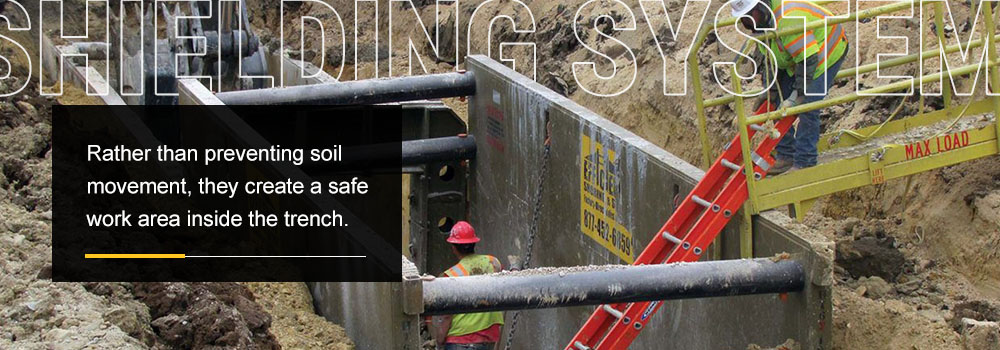
These shields are built to withstand tremendous force. They’re designed with reinforced walls and cross-bracing that can support thousands of pounds. This makes them especially useful in unstable soil conditions where preventing a collapse may be difficult.
The trade-off with shielding systems is their weight and size. Moving trench boxes typically requires heavy equipment, and positioning them correctly involves careful planning. However, for longer trench runs or projects with particularly challenging soil conditions, their robust protection often makes them the best choice.
Slide Rail Systems
Slide rail systems offer a more complex approach to trench protection. Often referred to as “dig and push” systems, they let crews advance the protective structure as excavation continues.
You will drive vertical rails into the ground, sliding horizontal panels between them to create a protective barrier against trench walls. These systems excel in deeper excavations or situations where shoring or shielding would be impractical.
Because of their modular nature, you can configure slide rails to handle various depths and soil types. They’re more labor-intensive to install than hydraulic shores, but they provide exceptional stability in challenging conditions.
Sloping and Benching
Sloping and benching are great alternatives to mechanical protective systems. Both methods involve cropping the trench walls back at an angle to prevent collapse.
As such, they rely on geometry rather than physical support. The specific slope angle will depend on the soil type. More stable soil allows for steeper slopes, while unstable soil calls for a gentler angle.
The main limitation of sloping and benching is space. Creating safe angles often means excavating well beyond the actual work area, which isn’t feasible in tight spaces or urban environments. Though they eliminate the need for equipment rental, utility lines and property boundaries often make these methods impractical.
How to Select the Right Protective System for Your Project
Choosing the right protective system requires a close assessment of your project conditions. The competent person on-site uses this information to match the excavation with the most appropriate protection method.
The Importance of Soil Type
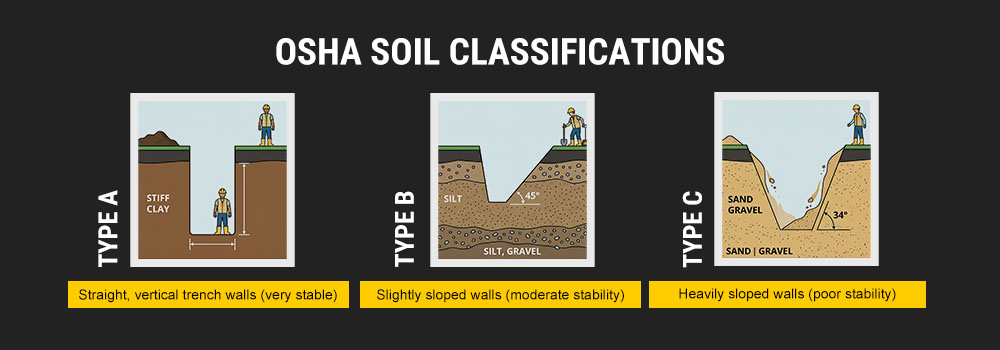
Soil type is the most important factor in selecting a protective system. OSHA classifies soil into three categories based on stability and compressive strength. Each type exerts different levels of pressure on trench walls.
- Type A soil: As the most stable classification, Type A includes cohesive soils like clay, silty clay, sandy clay and clay loam. The particles stick together well, which means Type A soil naturally resists collapse better than other types. However, soil cannot be classified as Type A if it’s fissured, previously disturbed, saturated with water or subject to vibration from heavy traffic or pile drivers. Because of its natural cohesion, Type A needs less support than other soil types.
- Type B soil: Moderately stable, Type B soil includes angular gravel, silt, silt loam and soils that have been cracked or disturbed. Type B soil often consists of particles that don’t stick together as well as Type A soil. This soil exerts higher pressure on trench walls, requiring trench shields and hydraulic shoring rated to handle moderate loads.
- Type C soil: The least stable classification, Type C soil includes granular soils like sand and gravel, where particles don’t stick together. Any soil with water seeping through it is automatically classified as Type C, regardless of its other characteristics. Type C soil exerts the greatest lateral pressure on protective systems. Thus, it requires the most robust shoring or trench boxes available.
It’s important to remember that a single trench can pass through multiple soil types. The competent person must evaluate conditions throughout the excavation and design protection based on the least stable soil present.
Key Project Factors to Assess
Several other factors influence protective system selection. Before digging, you’ll want to evaluate each element to support worker safety and regulatory compliance:
- Trench depth: Determines the scale of equipment required and whether professional engineering is needed.
- Water content and groundwater: Moisture significantly affects soil stability. Even soil that would otherwise qualify as Type A becomes Type C when saturated. Digging below the water table often requires robust hydraulic shores or tightly sheeted systems to prevent boiling or piping.
- Weather conditions: Rain can rapidly erode soil cohesion, and temperature changes affect soil behavior. Ongoing monitoring is essential throughout the project.
- Surcharge loads: Any weight resting on the surface near the trench increases the risk of collapse. Excavated spoil piles must be kept at least 2 feet back from the trench edge. Heavy equipment operating nearby adds pressure that protective systems must be equipped to handle.
- Nearby structures and vibrations: Digging too close to buildings, roads or utility poles can undermine their foundations. This situation often calls for rigid bracing solutions. Constant traffic or pile driving can introduce vibrations into compact soil and trigger sudden cave-ins.
- Underground and overhead utilities: All utilities must be located and marked before excavation begins. This is because accidentally striking gas lines, electrical conduits or water mains can result in explosions, electrocution or flooding. Choose protective systems that can be adjusted to avoid contact with existing infrastructure.
The Strategic Advantage of Renting Your Shoring Equipment
Now that you understand the factors involved in selecting a protective system, the case for renting equipment rather than owning becomes clear. Every project presents different soil conditions, trench dimensions and site constraints. Renting delivers strategic advantages that ownership cannot match:
- Get exactly what you need: Rather than making do with whatever you happen to own, you can specify the exact type, size and capacity you need for optimal safety and efficiency. Rent the equipment your project demands, whether that’s hydraulic shoring for an urban utility repair or heavy-duty trench boxes for an excavation in Type C soil.
- Pay only when you need it: Get shoring equipment when your project needs it and return it when the job is complete. This way, there’s no capital tied up in assets that depreciate when you’re not using them.
- Eliminate storage and transport costs: Shoring systems are large and heavy. As such, they require substantial warehouse space year-round. With ownership, you face ongoing storage fees. You also need specialized hauling equipment to move trench boxes and hydraulic shores between jobsites. Renting eliminates both of these expenses.
- Peace of mind with expert maintenance: OSHA requires that all protective systems be inspected and maintained in proper working condition. Rental equipment arrives professionally serviced, inspected and ready to meet current safety standards. This gives you confidence that the system protecting your crew is functioning as designed, without the burden of managing in-house maintenance.
Protect Your Crew With MacAllister Rentals
Running a safe, OSHA-compliant trenching operation calls for more than just knowing the rules. It also means access to the right protective equipment — professionally maintained and ready to deploy when you need it.
MacAllister Rentals offers a complete inventory of shoring equipment rentals designed to meet the demands of every soil type, trench depth and project timeline. Our fleet includes hydraulic shoring systems, trench boxes in multiple sizes and specialized equipment for challenging excavations.
We understand the importance of trenching safety. Our team works closely with construction professionals to match each project with the ideal protective system, whether that’s hydraulic shoring for tight urban jobs or trench boxes for longer runs. Every piece of equipment in our fleet is professionally inspected and maintained to meet current safety standards, giving you confidence that your crew is protected.
Ready to discuss your next project? Request a rental quote online, or contact our team of experts for personalized guidance. You can also call us at 877-700-1945 to speak with a rental specialist today.