Clearing land requires selecting the right equipment for the job. Equipment that’s too small extends timelines and may get damaged. Equipment that’s too large drives up rental, fuel and transport costs. Oversized equipment may also damage your terrain.
Choosing the right equipment starts with assessing your site and project. This analysis can save you thousands of dollars and weeks of frustration. Read along to learn about the ideal equipment for your project and tips on how to assess your site’s needs. You’ll also learn about the benefits of renting equipment for land clearing jobs.
Jump to Section:
- How to Evaluate Your Site
- Equipment for Different Land Clearing Projects
- Benefits of Renting Equipment for Land Clearing Jobs
- Partnering With a Trustworthy Rental Provider
- Find Land Clearing Equipment At MacAllister Rentals
How to Evaluate Your Site
Before selecting equipment, analyze your site’s terrain, soil type, acreage and vegetation density. These factors determine which equipment will work effectively and which will struggle or cause damage.
- Start with terrain assessment: Check whether the ground is sloped and by how many degrees. Steeper terrain requires equipment with better stability and traction.
- Evaluate current soil conditions: Soil type matters significantly. Sandy soil, clay and loam each respond differently to equipment weight and ground pressure. Wet clay turns slick and holds ruts. Sand shifts under weight but drains quickly. Wet conditions often require tracked equipment with lower ground pressure.
- Measure your acreage accurately: A quarter-acre lot with scattered brush demands different equipment than 10 acres of overgrown farmland. Underestimating acreage leads to renting equipment that’s underpowered for the job size.
- Assess your vegetation type and density: Are you dealing with light brush, saplings, mature trees or a mix of everything? Dense hardwood forests require more aggressive equipment than open areas with scattered brush. Large trees may need to be felled and processed before clearing can begin.
One critical consideration is protecting your topsoil. Blading with a dozer can remove valuable topsoil and increase erosion if not done correctly. If preserving topsoil is critical to your project, factor it into your equipment selection and clearing method.
Document your site’s condition before contacting any equipment providers. Taking photos and measurements helps rental teams recommend the right equipment.
Suitable Equipment for Different Land Clearing Projects
The right equipment depends on the scale of your job. Breaking down your options by the size and type of work helps you identify which equipment best matches your conditions and budget.
Small-Scale Clearing Equipment
Land clearing in tight spaces and near buildings requires smaller equipment. These units can maneuver in areas with limited access. They’re also suitable when preserving the surrounding greenery and structures is important. Some examples include:
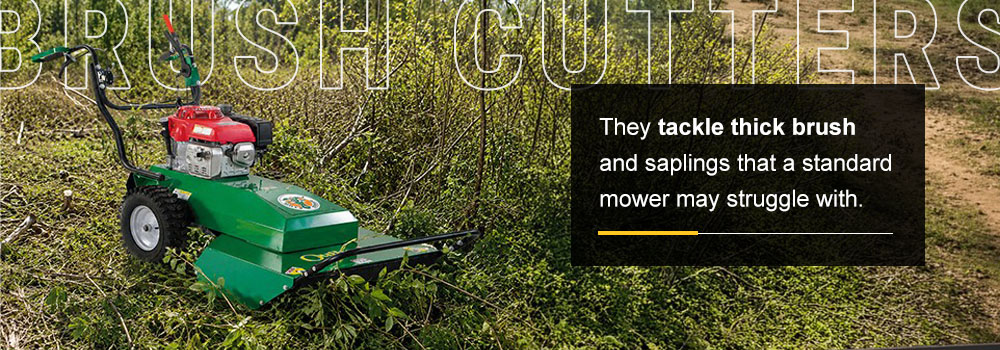
- Walk-behind brush cutters: Brush cutters tackle thick brush and saplings that a standard mower may struggle with. The cutting decks handle plants up to several inches in diameter. You can maneuver them through narrow gates and between buildings. They also go around landscaping features that would block larger equipment. They work best on level terrain where you can maintain a stable footing while guiding the equipment.
- Walk-behind stump grinders: After removing trees, you face the problem of leftover stumps. Walk-behind stump grinders use a rotating cutting wheel to grind stumps down. These tools are best for removing a few stumps, not dozens across a large site.
Midsize Clearing Equipment
Loaders and backhoes are versatile equipment, particularly for land clearing operations. Their primary value lies in their massive power and the ability to use a wide range of attachments. A single loader can switch from pushing over small trees to loading debris and grading rough terrain. The adaptability makes them ideal for many projects that need more than what walk-behind equipment can handle.
- Skid steer loaders: These are agile, jack-of-all-trades for land clearing. Skid steers perform best on firm, stable ground. Their compact size and tight turning radius allow you to work in confined areas. The wheeled design makes them easy to move and faster when traveling between work areas.
- Compact track loaders: These loaders are ideal for sites with high soil moisture or uneven terrain. The tracked undercarriage distributes weight over a larger surface area, reducing ground pressure. Low pressure prevents the equipment from sinking into soft ground. It also prevents rutting the terrain or causing soil compaction that may damage the site.
The choice between wheeled and tracked options depends on your specific site conditions. Sites with wet or sensitive terrain may need tracked equipment, such as compact track loaders, especially if one of your goals is maintaining soil structure. The trade-off is slower ground speeds than with skid steers.
Skid steers and compact track loaders accept a range of clearing attachments.
- Stump grinders: Stump grinder attachments handle stumps faster than walk-behind units. They are invaluable when you have many stumps spread across a site. The operator stays seated and protected while grinding. The host equipment can also reposition quickly between stumps.
- Forestry mulchers: Forestry mulcher attachments handle brush, saplings and small trees. They grind the material into mulch right on-site. You can use the mulched material to protect the soil from erosion and moisture loss. Mulchers remove the need for a separate chipping and hauling step on smaller sites.
- Root rakes: Root rake attachments for skid steers and compact track loaders catch roots and debris. They’re ideal for clearing brush piles and separating material for disposal. They also help prepare rough terrain without stripping topsoil.
Large-Scale Clearing Equipment
Heavy-duty equipment is your best option when clearing large areas or thick vegetation. These jobs often involve removing sizable trees and massive amounts of earth.
- Dozers: A dozer’s primary function is pushing over trees, clearing large areas of vegetation and grading land to a rough level. They work best across open areas, where their size and power enable them to clear large volumes quickly.
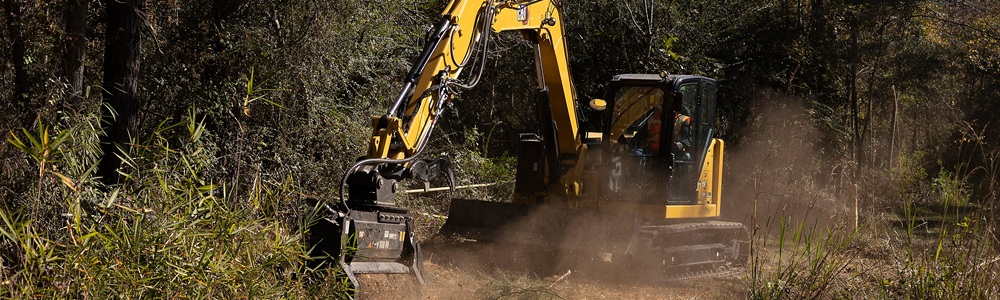
- Excavators: While dozers excel at pushing and grading, excavators handle digging and loading. The articulating boom and bucket let you dig out deep root systems, extract large stumps and trench for utilities or drainage. Their precision makes them valuable for selective work, such as digging around obstacles.
Low ground pressure (LGP) dozers use wider tracks to reduce ground pressure. They’re suitable for softer terrain where standard dozers would cause excessive rutting. The main advantage of dozers is their ability to cover ground fast when clearing large areas.
Dozers and excavators accept specialized attachments that expand their clearing capabilities.
- Excavator forestry mulchers: A mulcher attachment on an excavator handles thick brush and large trees that would overwhelm a skid steer. The excavator’s reach and strength let you mulch a wide area without repositioning the equipment as often.
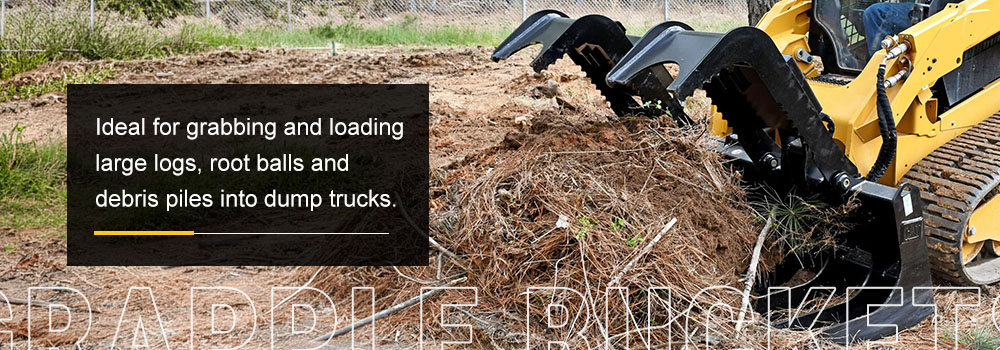
- Grapple buckets: Grapple buckets are ideal for grabbing and loading large logs, root balls and debris piles into dump trucks. They’re more efficient than standard buckets for clearing sites with heavy woody debris. They grip irregular material that would otherwise spill.
Dozers and excavators come in many sizes. Choosing the right one ensures you have enough power for the job and keeps rental costs in check.
Essential Support Equipment for Land Clearing
Clearing vegetation is only half the job. The other half involves managing the debris. Without the right support equipment, cleared material piles up and slows your progress. Some of the most essential support equipment for clearing operations include:
- Wood chippers: After cutting down trees and brush, you end up with piles of branches and woody material. Wood chippers process this material into manageable chips that compact efficiently for hauling. The chips can be removed or spread on-site as mulch, depending on your project. Chippers handle stems and branches that would otherwise need many trips with a dump truck in their raw form.
- Log splitters: Log splitters reduce large logs to manageable sizes for hauling. They’re especially useful when clearing trees that can be salvaged for firewood. They handle logs that are too large to chip, turning them into split pieces that load and stack more efficiently.
- Dump trucks and trailers: Moving debris off-site requires hauling capacity. Dump trucks handle rough terrain and are valuable on active clearing sites where access roads may be primitive or nonexistent. Dump trailers cost less for smaller jobs or when you already have suitable trucks to tow them.
Match your dump truck’s hauling capacity to the volume of debris you’re generating. Doing this helps avoid bottlenecks or excess costs in your operation.
Benefits of Renting Equipment for Land Clearing Jobs
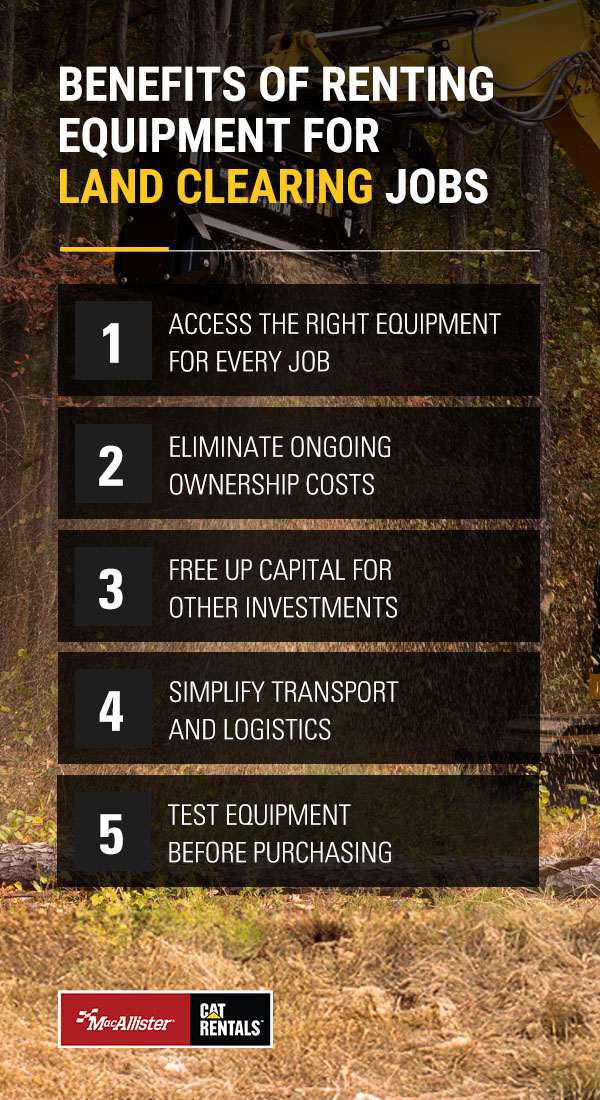 Here are some reasons why renting equipment for your land clearing projects may be the smartest choice.
- Access the right equipment for every job: When you rent, you can choose the best equipment for each job rather than trying to make do with what you have. Site conditions, vegetation density and acreage vary from project to project. The right equipment choice can push your costs toward the lower end of that range.
- Eliminate ongoing ownership costs: Renting helps you avoid long-term storage fees and depreciation costs. The rental price may also include maintenance, repairs and insurance.
- Free up capital for other investments: Renting often makes more financial sense when equipment is used less than 40% of the time. For project-based clearing work, reaching a utilization threshold that justifies buying may be hard to achieve. Renting keeps your capital available for business investments that deliver returns year-round.
- Simplify transport and logistics: Dozers, excavators and loaders often require specialized transport equipment. Reputable rental providers include delivery and pickup as part of the service.
- Test equipment before purchasing: Renting lets you see how the equipment performs on the job before you commit to buying and can help you make more informed financial decisions.
Partnering With a Trustworthy Rental Provider
Choosing the right rental company matters as much as choosing the right equipment. A good rental provider becomes a resource for project planning and problem-solving. Experienced providers will suggest equipment combinations you might overlook. They also alert you to potential issues based on their experience with similar jobs. This consultation can prevent expensive mistakes before they happen. It’s essential to know what to look for in that relationship. The best providers add value beyond equipment access.
Consider these factors before committing to a rental agreement:
- Transport and delivery costs: Hauling heavy equipment to your site adds expense. Confirm whether the rental rate covers delivery and pickup. If not, factor in these costs into your total budget.
- Equipment breakdown policy: Determine what happens if equipment fails during your rental period, including understanding the provider’s repair or replacement response time. Downtime costs you money through delayed schedules and idle labor. The provider’s breakdown policy and response capability matter as much as their rental rates.
- Customer support availability: Problems and questions can arise at any time, not just during business hours. Ask whether they can handle urgent situations outside regular hours. Rental companies that offer support during and after your rental period make it easier to solve problems.
- Parts and attachment availability: Access to the right attachments lets you do more with just one piece of equipment. Always check what attachments are available and if you can switch between them easily during your rental period. Parts availability matters when minor repairs or adjustments become necessary.
Working with a rental provider who checks all these boxes can give you peace of mind that you are forming a genuine partnership. The best companies know that contractors need good advice and dependable help, as well as access to a wide range of equipment.
Find the Right Land Clearing Equipment With MacAllister Rentals
Picking the best rental equipment for land clearing requires thoughtful consideration. Make sure the equipment you choose has the right mix of power, maneuverability and ability to handle your terrain. Every site presents unique challenges that benefit from professional input.
At MacAllister Rentals, our team brings the hands-on expertise to help you confirm your equipment choice before you commit. We also offer a full range of rental equipment. From walk-behind brush cutters and skid steer loaders to excavators and dozers, we have what your project demands. We only offer equipment from trusted brands like Cat®, Vermeer and Toro.
For over eight decades, our team has supported contractors and landowners across Indiana and Michigan’s lower peninsula with equipment and technical advice. Explore our rental equipment inventory to see available options. You can also contact our team to discuss your land-clearing project. We’re here to help you select the right equipment and get started.